
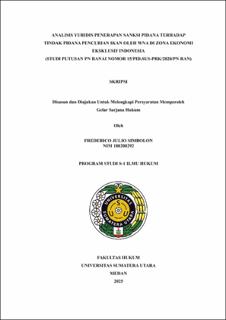
Analisis Yuridis Penerapan Sanksi Pidana terhadap Tindak Pidana Pencurian Ikan oleh WNA di Zona Ekonomi Eksklusif Indonesia (Studi Putusan PN Ranai Nomor 15/Pid.Sus-Prk/2020/PN Ran)
Juridical Analysis of the Implementation of Criminal Sanctions for the Crime of Illegal Fishing by Foreign Nationals in Indonesia’s Exclusive Economic Zone (Case Study of Ranai District Court Decision Number 15/Pid.Sus-Prk/2020/PN Ranai)
Abstract
The Exclusive Economic Zone (EEZ) of Indonesia is a strategically important maritime area rich in fishery resources, but it is highly vulnerable to illegal fishing practices by foreign vessels. This activity not only threatens the sustainability of marine ecosystems but also has serious impacts on the national economy, state sovereignty, and results in significant losses for Indonesia in the form of depleted fish stocks and reduced welfare for local fishermen who rely on the fisheries sector for their livelihoods. This study aims to analyze the legal application of criminal sanctions against illegal fishing by Foreign Nationals (WNA), through a study of the Ranai District Court Decision Number 15/Pid.Sus-PRK/2020/PN Ran. This research emphasizes the importance of synergy between national regulations, maritime surveillance policies, and inter-agency coordination in addressing illegal fishing cases comprehensively. There is a need for an update in criminal policies in the marine and fisheries sectors that is more progressive, as well as a law enforcement approach capable of providing substantive justice for the victimized state, Indonesia. The study uses a normative juridical method with an approach based on legislation and case studies. The analysis results indicate that the criminal sanctions applied in the decision do not fully reflect the firmness of national law, particularly in Law Number 31 of 2004 in conjunction with Law Number 45 of 2009 on Fisheries, and are not optimally aligned with the principles of international maritime law as stipulated in UNCLOS 1982. The judge's decision is considered weak in considering the deterrent effect on foreign perpetrators and does not fully protect the state's sovereignty over its maritime territory. This highlights the importance of policy reform and strengthening inter-agency coordination to ensure effective and strategic law enforcement in the EEZ. This research is expected to enrich the academic discourse and provide input for the formulation of national legal policies in the marine and fisheries sectors.
Collections
- Undergraduate Theses [3144]