| dc.contributor.advisor | Lubis, Rafiqoh | |
| dc.contributor.advisor | Marlina | |
| dc.contributor.author | Situmorang, Agnes Marsella | |
| dc.date.accessioned | 2025-07-11T08:42:40Z | |
| dc.date.available | 2025-07-11T08:42:40Z | |
| dc.date.issued | 2025 | |
| dc.identifier.uri | https://repositori.usu.ac.id/handle/123456789/105300 | |
| dc.description.abstract | Environmental activists in Indonesia often face criminalisation or legal
pressure when they try to fight for environmental interests. An example is an
environmental activist named Daniel Frits who voiced the rejection of illegal
shrimp ponds in Karimunjawa, in law enforcement, judges must accept, examine,
decide and resolve every case submitted to them. The problems in this thesis
entitled Analysis of Conviction Decisions and Decisions Released from All
Charges for Criminal Acts of Hate Speech Committed by Environmental Activists
are how is the regulation related to the criminal act of hate speech in Indonesian
criminal law, how is the relationship between proving the elements of a criminal
act and the form of a judge's decision, how is the difference in the judge's
consideration in proving the criminal act of hate speech committed by
environmental activists in District Court Decision Number 14/Pid.Sus/2024/PN.
Jpa and Court Decision Number 374/Pid.Sus/2024/PT.Smg? This research is
conducted with descriptive normative analysis method and the data used is
secondary data, then the data is analysed qualitatively to answer the problems in
this paper. The regulation of the criminal offence of hate speech is regulated in
Article 45A paragraph (2) Jo. Article 28 paragraph (2) of Law No. 1 Year 2024.
Evidentiary arrangements in Indonesian criminal procedure law can be found
scattered in the Criminal Procedure Code and several other special laws and
other laws under it. Based on Article 183 of KUHAP, the evidentiary system in
Indonesia is a negative statutory evidentiary system with the principle of minimum
proof. In the end, based on the results of this research, it was concluded that the
judges of the Jepara District Court tended to prioritise the formal elements of the
criminal offence of hate speech regardless of the status of the defendant who was
an environmental activist. Therefore, the Semarang High Court judge overturned
the District Court's decision with the consideration of protecting activists who
voice environmental issues and released the defendant from all charges. | en_US |
| dc.language.iso | id | en_US |
| dc.publisher | Universitas Sumatera Utara | en_US |
| dc.subject | Environmental Activist | en_US |
| dc.subject | Evidence | en_US |
| dc.subject | Hate Speech | en_US |
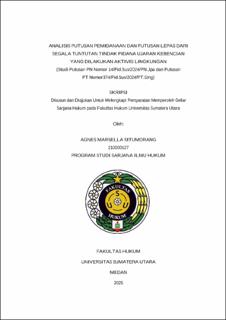
| dc.title | Analisis Putusan Pemidanaan dan Putusan Lepas Dari Segala Tuntutan Tindak Pidana Ujaran Kebencian Yang Dilakukan Aktivis Lingkungan (Studi Putusan PN Nomor 14/Pid.Sus/2024/PN.Jpa Dan Putusan PT Nomor 374/Pid.Sus/2024/PT.Smg) | en_US |
| dc.title.alternative | Analysis of the Judgment of Conviction and the Decision of Release From All Charges of the Criminal Action of Violence Committed by Environmental Activists (Study of District Court Decision Number 14/Pid.Sus/2024/PN.Jpa And PT Decision Number 374/Pid.Sus/2024/PT.Smg) | en_US |
| dc.type | Thesis | en_US |
| dc.identifier.nim | NIM210200127 | |
| dc.identifier.nidn | NIDN0025077403 | |
| dc.identifier.nidn | NIDN0007037501 | |
| dc.identifier.kodeprodi | KODEPRODI74201#Ilmu Hukum | |
| dc.description.pages | 184 Pages | en_US |
| dc.description.type | Skripsi Sarjana | en_US |
| dc.subject.sdgs | SDGs 16. Peace, Justice And Strong Institutions | en_US |