| dc.description.abstract | In the digital age, the role of mosques as centers of religious, social, and cultural activities has shifted, often limited to ritual worship functions. The participation of Generation Z in mosques tends to decline due to differences in lifestyle, social interaction needs, and a lack of inclusive spaces that are relevant to their daily lives. Therefore, designing Generation Z-friendly mosques with an inclusive architectural approach is an important strategy to restore the role of mosques as open and meaningful shared spaces.
This study uses a mixed methods approach, where exploratory qualitative techniques are used to inform the research-based design method, which focuses on the characteristics, needs, and issues of Generation Z. Data was collected through literature reviews, field observations, interviews, and questionnaires, then analyzed to formulate a contextual, participatory, and humanistic design concept.
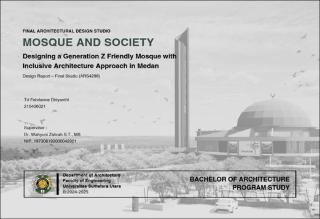
The study results indicate that an inclusive architectural approach can bridge the spiritual and social needs of Generation Z and revive the role of the mosque as a relevant public space. The resulting design places the mosque as the central building on the site, surrounded by functional spaces. supporting facilities such as community rooms, coworking spaces, discussion areas, and open zones. The relationship between buildings is direct and integrated both visually and functionally enabling cross-space interaction and activities.
A main circulation route in the form of a ramp from the entrance gate takes visitors directly to the mosque with disability-friendly access. The ramp wall also functions as an educational medium—containing information about Islam, the values of diversity, and a visual narrative of the history of da'wah. The main prayer hall is designed to be adaptive and open, with flexibility for various community activities outside of prayer times. User movement patterns are accommodated through circulation paths that flow seamlessly, divided into zones for men, women, and universal access. The building's facade expresses openness through wide openings without massive walls, featuring columns and grilles that allow for natural cross-ventilation. The materials used are local and environmentally friendly, such as wood and plain concrete, creating a simple yet warm and welcoming feel for both the younger generation and the general public. | en_US |