| dc.description.abstract | Indonesia, as one of the countries with the largest Muslim
population in the world, also has a significant millennial
population. This generation needs a physical space that not
only serves as a place of worship, but also supports social
activities and self-development that suit their character and
lifestyle. Therefore, a residential neighborhood-scale Muslim
millennial community center with an embracing empathic
architectural approach is able to address their social and
spiritual needs in a balanced manner.
The methodology used is research-based design that
focuses on the characteristics, needs, and problems of
millennials. Data were collected through literature studies, field
observations, interviews, and questionnaires to Muslim
millennials in Medan city, then analyzed to formulate design
concepts elaborated through the principles of empathic
architecture to produce functionally and emotionally relevant
design solutions.
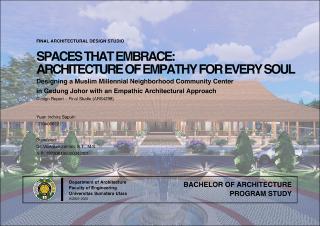
The result of this study is the design of a community center
with an empathic architecture theme applied in a program of
spaces and activities such as mosques, multipurpose halls,
pavilions, educational spaces, commercial spaces, parks, and
sports facilities. The main concept is embracing space, which is
the composition of building masses that "hug" public spaces as
the heart of shared activities. These spaces are designed for all
ages and walks of life, with interactive experiences such as curbside seating, dining areas and shops, open-air libraries, and
sports fields.
Architecturally, the design is developed through zoning that
strategically separates quiet and active areas, and pedestrian
circulation that connects zones with a progressive spatial
experience. The mass layout is designed to be open and
human-scaled, while the building façade features natural
materials, wide openings, and simple yet expressive forms.
Several elements such as open shaded spaces, informal circular
seating areas, and landscape integration are part of the
architectural details that support user interaction and emotional
comfort. In addition, the empathic approach is also realized
through the use of facade details inspired by the Javanese
community in Medan Johor, as well as the presence of an open
pavilion and multipurpose building as a form of empathy for the
traditions and communal activities of the local community.
The design not only addresses functional needs, but also
provides an immersive and empowering spatial experience,
making it a place of social and spiritual growth for Muslim
millennials in the contemporary urban context. | en_US |