| dc.contributor.advisor | Harianto, Dedi | |
| dc.contributor.advisor | Mulhadi | |
| dc.contributor.author | Supriyadiputri, Riska Andini | |
| dc.date.accessioned | 2025-07-23T08:11:47Z | |
| dc.date.available | 2025-07-23T08:11:47Z | |
| dc.date.issued | 2025 | |
| dc.identifier.uri | https://repositori.usu.ac.id/handle/123456789/106403 | |
| dc.description.abstract | Honey adulteration cases rank third for most commonly adulterated foods, after milk and olive oil. The development of technology through social media influences the relentless spread of honey products and makes it difficult for consumers to be selective. It is necessary to standardize honey management that binds honey circulation with legally enforceable rules. The purpose of this study is to describe and discuss the form of standardization of honey management, the form of liability of business actors in producing and distributing honey products without Veterinary Control Number Certification, and to find out the form of consumer protection if consumers suffer losses due to non-fulfillment of the application of honey product standardization.
The type of research used in writing this thesis is normative juridical research using primary and secondary data, namely with a statutory approach (statue approach) and conceptual approach (conceptual approach). The data collection technique in writing this thesis uses library research and field research and the data is analyzed qualitatively.
The results of this study show that the form of standardization of honey management is in accordance with the rules of food quality standards through PERMENTAN Number 11 of 2020 which requires the application of Veterinary Control Number Certification with quality assessment through SNI 8664: 2018. The form of accountability for business actors who do not comply with the Veterinary Control Number Certification will receive administrative sanctions in stages in the form of written warnings, temporary suspension to revocation of business licenses. Non-compliance of business actors with the law actually causes harm to consumers. The form of consumer protection is present through Law Number 8 Year 1999 on Consumer Protection which guarantees protection to consumers, through consumer rights, guidance and supervision of technical institutions. | en_US |
| dc.language.iso | id | en_US |
| dc.publisher | Universitas Sumatera Utara | en_US |
| dc.subject | Consumer Protection | en_US |
| dc.subject | Honey Products | en_US |
| dc.subject | Certification | en_US |
| dc.subject | Veterinary Control Number | en_US |
| dc.subject | Social Media | en_US |
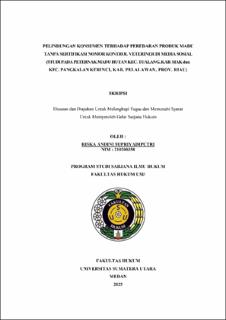
| dc.title | Pelindungan Konsumen terhadap Peredaran Produk Madu Tanpa Sertifikasi Nomor Kontrol Veteriner di Media Sosial (Studi pada Peternak Madu Hutan Kec.Tualang, Kab.Siak, dan Kec.Pangkalan Kerinci, Kab.Pelalawan, Prov.Riau) | en_US |
| dc.title.alternative | Consumer Protection Against The Trade of Madu Products Without Veterinary Control Number Certification in Social Media (Study on Hutan Madu Farmers Kec.Tualang, Kab.Siak and Kec.Pangkalan Kerinci, Kab.Pelalawan, Prov.Riau) | en_US |
| dc.type | Thesis | en_US |
| dc.identifier.nim | NIM210200358 | |
| dc.identifier.nidn | NIDN0020086905 | |
| dc.identifier.nidn | NIDN0004087303 | |
| dc.identifier.kodeprodi | KODEPRODI74201#Ilmu Hukum | |
| dc.description.pages | 179 Pages | en_US |
| dc.description.type | Skripsi Sarjana | en_US |
| dc.subject.sdgs | SDGs 12. Responsible Consumption And Production | en_US |