| dc.contributor.advisor | Yunara, Edi | |
| dc.contributor.advisor | Nurmalawaty | |
| dc.contributor.author | Silaban, Yohanna | |
| dc.date.accessioned | 2025-07-24T03:22:26Z | |
| dc.date.available | 2025-07-24T03:22:26Z | |
| dc.date.issued | 2025 | |
| dc.identifier.uri | https://repositori.usu.ac.id/handle/123456789/106771 | |
| dc.description.abstract | Child sexual intercourse is one form of sexual violence that violates moral norms, driven by an adult’s desire to attain sexual gratification by exploiting a child who is weak and powerless. In many cases, the perpetrator is someone close to the victim, particularly the biological father. Moreover, proving cases of child sexual intercourse committed by the biological father often presents significant challenges, as such incidents usually occur in a domestic setting and are known only to the perpetrator and the child.This study discusses several issues: how the law regulates the criminal offense of child sexual intercourse committed by a biological father according to Indonesian legal provisions; how evidentiary rules are applied to such crimes under Indonesia’s criminal procedural law; and how judges evaluate evidence in convicting perpetrators in Decision No. 604/Pid.Sus/2023/PN PTK and Decision No. 122/Pid.Sus/2023/PN Tar.
The type of research employed is normative juridical legal research, which relies on secondary data sources and applies both statutory and case approaches. Data collection was conducted through literature studies, with the analysis carried out using a qualitative method presented in a structured and systematic manner.
The findings of the study indicate that there are several legal provisions regulating the criminal offense of child sexual intercourse, especially when the perpetrator is a parent. These provisions also include those related to aggravated sentencing that may be applied. Although proving child sexual intercourse by a biological father is not easy and tends to be more complex, the perpetrator can still be held criminally liable and convicted through careful and thorough judicial consideration. However, the prison sentence was handed down in Decision No. 604/Pid.Sus/2023/PN PTK shows that the imposition of aggravated penalties for perpetrators who are parents has not been given sufficient attention or consideration by the court. In contrast, Decision No. 122/Pid.Sus/2023/PN Tar demonstrates that the court did apply aggravated sentencing in determining the punishment. | en_US |
| dc.language.iso | id | en_US |
| dc.publisher | Universitas Sumatera Utara | en_US |
| dc.subject | Child Intercourse | en_US |
| dc.subject | Evidentiary | en_US |
| dc.subject | Judge’s Consideration | en_US |
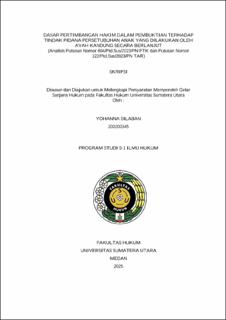
| dc.title | Dasar Pertimbangan Hakim Dalam Pembuktian Terhadap Tindak Pidana Persetubuhan Anak Yang Dilakukan Oleh Ayah Kandung Secara Berlanjut (Analisis Putusan Nomor 604/Pid.Sus/2023/Pn Ptk Dan Putusan Nomor 122/Pid.Sus/2023/Pn Tar) | en_US |
| dc.title.alternative | Judicial Considerations in the Evidentiary Process of the Criminal Offense of Child Sexual Intercourse Committed Continuously by the Biological Father (An Analysis of Verdict No. 604/Pid.Sus/2023/PN PTK and Verdict No. 122/Pid.Sus/2023/PN Tar) | en_US |
| dc.type | Thesis | en_US |
| dc.identifier.nim | NIM200200345 | |
| dc.identifier.nidn | NIDN0022126005 | |
| dc.identifier.nidn | NIDN0007096203 | |
| dc.identifier.kodeprodi | KODEPRODI74201#Ilmu Hukum | |
| dc.description.pages | 140 Pages | en_US |
| dc.description.type | Skripsi Sarjana | en_US |
| dc.subject.sdgs | SDGs 16. Peace, Justice And Strong Institutions | en_US |