
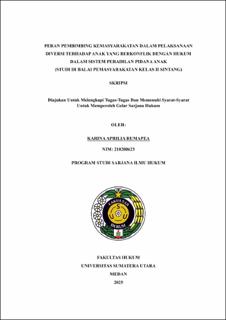
Peran Pembimbing Kemasyarakatan Dalam Pelaksanaan Diversi Terhadap Anak Yang Berkonflik Dengan Hukum Dalam Sistem Peradilan Pidana Anak (Studi di Balai Pemasyarakatan Kelas II Sintang)
The Role Of The Correctional Counselor In The Implementation Of Diversion For Children In Conflict With The Law In The Juvenile Criminal Justice System (A Study at The Class II Correctional Center in Sintang)
Abstract
Diversion is the alternative approach of cases involving children in conflict the law
through non-formal judicial processes, emphasizing the principles of restorative
justice. The implementation of diversion aims to avoid the negative impact of
criminal proceedings on children, while promoting reconciliation between the
offender, the victim, and the community. The implementation of diversion requires
the involvement of correctional counselors who play a role in conducting
community research, providing assistance, guidance, and supervision to children in
conflict with the law. This study aims to analyze the legal framework for diversion
in Indonesia, the role of correctional counselors in the implementation of diversion
at the Class II Correctional Center in Sintang, and the obstacles they face, as well
as the efforts to overcome these challenges. This research uses a normative
empirical method with a descriptive-analytical approach. The data used consists of
primary data obtained through interviews with correctional counselors at the Class
II Correctional Center in Sintang, and secondary data obtained through literature
studies from books, journals, and relevant legislation. The results show that the
implementation of diversion in Indonesia is regulated under Law Number 11 of
2012 concerning the Juvenile Criminal Justice System and Government Regulation
Number 65 of 2015 concerning Guidelines for the Implementation of Diversion and
the Handling of Children Under 12 Years Old. The diversion process requires
correctional counselors to play a key role from the investigation, prosecution, and
trial stages, although its implementation still faces obstacles such as limited
facilities and lack of inter-agency communication. Nevertheless, the success rate of
diversion at the Class II Correctional Center in Sintang is relatively high, indicating
that with adequate support, the diversion process can be effectively implemented
and bring benefits to the child, the victim, and the community.
Collections
- Undergraduate Theses [3144]