| dc.contributor.advisor | Saidin | |
| dc.contributor.advisor | Azwar, Tengku Keizerina Devi | |
| dc.contributor.author | Barus, Zefanya Brigitha | |
| dc.date.accessioned | 2025-07-24T06:15:15Z | |
| dc.date.available | 2025-07-24T06:15:15Z | |
| dc.date.issued | 2025 | |
| dc.identifier.uri | https://repositori.usu.ac.id/handle/123456789/107052 | |
| dc.description.abstract | A brand is a sign used as an identifier for goods or services. A brand is not
only a symbol and differentiator of a business but also reflects the reputation and identity of a business. Registering a brand with the Minister is the basis for brand protection so that the brand owner obtains the right to the brand to be able to use it themselves or allow other parties to use the registered brand. In practice, many trademarks have similarities in the use of design, letters, or colors with other trademarks. Disputes over similarities in brands in Indonesia include disputes between the brands Gudang Garam vs Gudang Baru, Bon Cabe vs Bon Nori, Geprek Bensu vs I Am Geprek Bensu, and Kok Tong vs Lim Kok Tong.
The method used in this research is normative legal research using
secondary data sources. Data were taken from primary, secondary, and tertiary legal materials. The data collection technique used was a literature study, where the data was processed and analysed qualitatively using a legislative approach and a case study approach.
The results of this study demonstrate the need for specific legal regulations regarding trademark registration to prevent problems related to substantial similarity between registered trademarks. An analysis of judges' decisions in several cases concerning substantial similarity revealed differences in the judges' considerations in issuing rulings on trademarks with substantial similarity. Therefore, more specific legal regulations must be amended or added regarding the criteria or elements of substantial similarity for trademarks to be cancelled. In the event of cancellation of a trademark with substantial similarity, the party whose trademark is cancelled is required to cease all production or distribution of
goods or services related to the cancelled trademark. Trademark cancellation, which is decided through a court decision, requires the Directorate General of Intellectual Property Rights to remove the cancelled registered trademark. | en_US |
| dc.language.iso | id | en_US |
| dc.publisher | Universitas Sumatera Utara | en_US |
| dc.subject | Trademark | en_US |
| dc.subject | Essential Similarity | en_US |
| dc.subject | Trademark Cancellation | en_US |
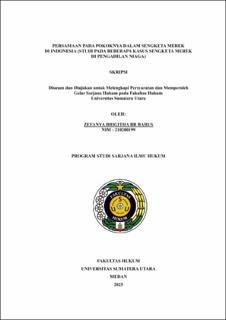
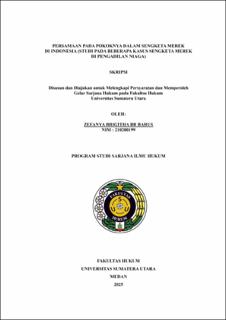
| dc.title | Persamaan Pada Pokoknya Dalam Sengketa Merek di Indonesia (Studi pada Beberapa Kasus Sengketa Merek di Pengadilan Niaga) | en_US |
| dc.title.alternative | Essential Similarities in Trademark Disputes in Indonesia (A Study of Several Trademark Dispute Cases in the Commercial Court | en_US |
| dc.type | Thesis | en_US |
| dc.identifier.nim | NIM210200199 | |
| dc.identifier.nidn | NIDN0013026203 | |
| dc.identifier.nidn | NIDN0001027001 | |
| dc.identifier.kodeprodi | KODEPRODI74201#Ilmu Hukum | |
| dc.description.pages | 95 Pages | en_US |
| dc.description.type | Skripsi Sarjana | en_US |
| dc.subject.sdgs | SDGs 16. Peace, Justice And Strong Institutions | en_US |