| dc.contributor.advisor | Yunara, Edi | |
| dc.contributor.advisor | Lubis, Rafiqoh | |
| dc.contributor.author | Hasibuan, Rayhan Ryamizard | |
| dc.date.accessioned | 2025-07-24T06:19:05Z | |
| dc.date.available | 2025-07-24T06:19:05Z | |
| dc.date.issued | 2025 | |
| dc.identifier.uri | https://repositori.usu.ac.id/handle/123456789/107061 | |
| dc.description.abstract | Criminal acts often involve more than one perpetrator, where the relationship between the perpetrators can affect their legal accountability. Evidence in criminal cases is very important to determine whether the defendant actually committed the act charged, because it concerns human rights, especially if there is an error in sentencing an innocent party. Such as in the crime of forgery of documents involving a notary. This thesis has three problem formulations: 1) how is the regulation of the crime of forgery of documents related to the performance of a notary according to criminal law in Indonesia? 2) how is the relationship between proving the elements of the crime and the form of the judge's decision according to Indonesian criminal procedure law? 3) how are the differences in the judge's considerations in proving the element of participation in the crime of forgery of documents committed by a notary in (District Court Decision Number 773 / Pid.B / 2021 / PN Smg and the High Court Decision Number 153 / Pid / 2022 / PT Smg?) The research method used is normative legal research using secondary data. The research method used is normative legal research using secondary data. The results of the study show that a notary, as a public official based on the Notary Public Law. Notaries have criminal and administrative responsibilities if proven to have committed forgery. Proof is carried out in accordance with Article 183 of the Criminal Procedure Code with a negative proof system, namely it must be based on valid evidence and the judge's conviction. In the case analyzed, the District Court issued a verdict based on Article 264 paragraph (1) in conjunction with Article 55 paragraph (1) of the Criminal Code, while the High Court upheld the verdict against defendant I and overturned the verdict against defendant II. The defendants in this case have fulfilled the element of participation, namely that there is a conscious cooperation between the participants and the participants have carried it out. | en_US |
| dc.language.iso | id | en_US |
| dc.publisher | Universitas Sumatera Utara | en_US |
| dc.subject | Proof | en_US |
| dc.subject | Forgery | en_US |
| dc.subject | Participation | en_US |
| dc.subject | Notary | en_US |
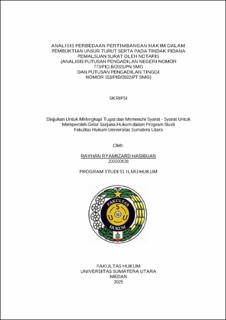
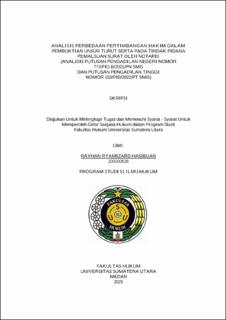
| dc.title | Analisis Perbedaan Pertimbangan Hakim dalam Pembuktian Unsur Turut Serta pada Tindak Pidana Pemalsuan Surat oleh Notaris (Analisis Putusan Pengadilan Negeri Nomor 773/Pid.B/2021/PN SMG dan Putusan Pengadilan Tinggi Nomor 153/Pid/2022/PT SMG) | en_US |
| dc.title.alternative | Analysis of the Differences in Judges Considerations in Proving the Element of Participation in the Criminal Act of Forgery of Documents by a Notary (Analysis of District Court Decision Number 773/Pid.B/2021/PN SMG and High Court Decision Number 153/Pid/2022/PT SMG) | en_US |
| dc.type | Thesis | en_US |
| dc.identifier.nim | NIM200200636 | |
| dc.identifier.nidn | NIDN0025077403 | |
| dc.identifier.kodeprodi | KODEPRODI74201#Ilmu Hukum | |
| dc.description.pages | 174 Pages | en_US |
| dc.description.type | Skripsi Sarjana | en_US |
| dc.subject.sdgs | SDGs 16. Peace, Justice And Strong Institutions | en_US |