| dc.contributor.advisor | Syahrin, Alvi | |
| dc.contributor.advisor | Lubis, Rafiqoh | |
| dc.contributor.author | Hutabalian, Alwi Nicholas | |
| dc.date.accessioned | 2025-07-24T09:41:52Z | |
| dc.date.available | 2025-07-24T09:41:52Z | |
| dc.date.issued | 2025 | |
| dc.identifier.uri | https://repositori.usu.ac.id/handle/123456789/107264 | |
| dc.description.abstract | In Indonesia, Restorative Justice has now been incorporated into the Criminal Justice System, which previously emphasized punishment of perpetrators of crimes and now leads to the protection of victims. Restorative Justice is a resolution of a crime by emphasizing restoration to the original state. However, in implementing the principles of Restorative Justice there are still imperfections due to the presence of sectoral regulations in each law enforcement agency that only focus on their respective institutions, causing misalignment in its application. This thesis contains several problem formulations, namely as follows: 1). How is the principle of Restorative Justice and its development in Indonesian criminal law; 2. How is the protection of victims of crime in settlement through Restorative Justice; 3. How is the harmonization of Restorative Justice arrangements in Prosecutor's Regulation Number 15 of 2020 and Police Regulation Number 8 of 2021 related to victim protection. The research method used in writing this thesis is the normative juridical method using secondary data obtained from primary, secondary and tertiary materials. The data analysis used in this research is qualitative analysis and literature study. At the end of this research, it can be concluded that the Prosecutor's Regulation Number 15 of 2020 and Police Regulation Number 8 of 2020 still can’t accommodate the Principles of Restorative Justice even though both are oriented towards restoring the original situation. There are differences in the fulfillment of victims' rights in the prosecutor's regulation can be excluded if the perpetrator and victim agree to reconcile, but in the police regulation the fulfillment of victims' rights must still be fulfilled even though they have reconciled. The Restorative Justice process can be carried out if there is an agreement between the perpetrator and the victim, with the intention that if there is no agreement then Restorative Justice will not occur and the fulfillment of the victim's rights will not be fulfilled. | en_US |
| dc.language.iso | id | en_US |
| dc.publisher | Universitas Sumatera Utara | en_US |
| dc.subject | Harmonization | en_US |
| dc.subject | Restorative Justice | en_US |
| dc.subject | Victim Protection | en_US |
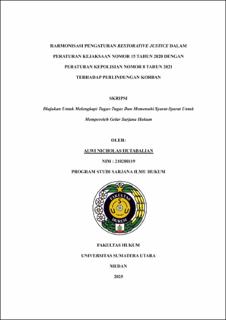
| dc.title | Harmonisasi Pengaturan Restorative Justice dalam Peraturan Kejaksaan Nomor 15 Tahun 2020 dengan Peraturan Kepolisian Nomor 8 Tahun 2021 terhadap Perlindungan Korban | en_US |
| dc.title.alternative | Harmonization of Restorative Justice Arrangements in Prosecutor's Regulation Number 15 of 2020 with Police Regulation Number 8 of 2021 towards Victim Protection | en_US |
| dc.type | Thesis | en_US |
| dc.identifier.nim | NIM210200119 | |
| dc.identifier.nidn | NIDN0031036302 | |
| dc.identifier.nidn | NIDN0025077403 | |
| dc.identifier.kodeprodi | KODEPRODI74201#IlmuHukum | |
| dc.description.pages | 209 Pages | en_US |
| dc.description.type | Skripsi Sarjana | en_US |
| dc.subject.sdgs | SDGs 16. Peace, Justice And Strong Institutions | en_US |