| dc.contributor.advisor | Nurmalawaty | |
| dc.contributor.advisor | Trisna, Wessy | |
| dc.contributor.author | Silaban, Laureza Nanda Putri | |
| dc.date.accessioned | 2025-07-24T10:12:52Z | |
| dc.date.available | 2025-07-24T10:12:52Z | |
| dc.date.issued | 2025 | |
| dc.identifier.uri | https://repositori.usu.ac.id/handle/123456789/107288 | |
| dc.description.abstract | Judges considerations in handling narcotics cases must consider the value of social justice, not only legal certainty. Judges have the duty to receive, exam- ine, try and decide cases, meaning resolving criminal disputes. Judges are ordi- nary human beings with all their weaknesses and shortcomings placed in a cen- tral position in upholding law and justice. However, there are a number of judges' decisions that impose sentences below the minimum criminal threat. This law en- forcement practice shows a phenomenon that attracts everyone's attention. The decisions of these judges raise various questions regarding the consistency of law enforcement and the judges' understanding of the objectives of the Narcotics Law itself. The method used in writing this thesis is a normative legal method by referring to secondary data in the form of primary, secondary, and tertiary legal materials with a research approach of the statutory regulatory approach and a case approach through the method of collecting library research as the main data. Data analysis in this study uses qualitative methods. The results of the study indicate that the legal provisions on the imposition of minimum criminal sanctions are not explicitly explained. Judges in imposing criminal sentences may not impose criminal sentences exceeding the maximum criminal threat or below the minimum criminal threat because in every law and regulation the minimum and maximum limits have been regulated. The imposition of criminal sanctions below the minimum can be categorized as a form of deviation from legal norms. Although judges have freedom, the judge's authority is limited by laws and regulations. The conclusion of the analysis in this study is that the criteria considered by judges in imposing sentences below the minimum in narcotics crime cases are that the defendant is indicated to have taken/received crystal methamphetamine, the defendant's actions in receiving crystal methamphetamine in a certain place are very close in time, namely the arrest of the defendant is still in the series of receiving crystal methamphetamine | en_US |
| dc.language.iso | id | en_US |
| dc.publisher | Universitas Sumatera Utara | en_US |
| dc.subject | Narcotics Crimes | en_US |
| dc.subject | Criminal Threats Below Minimum | en_US |
| dc.subject | Criminal Sanctions | en_US |
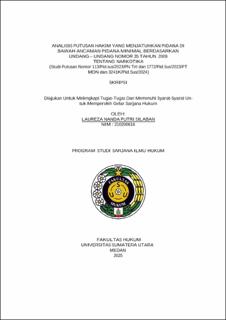
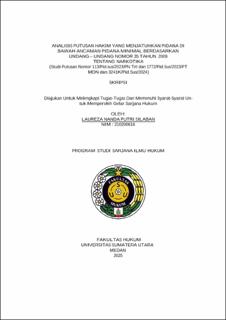
| dc.title | Analisis Putusan Hakim yang Menjatuhkan Pidana di Bawah Ancaman Pidana Minimal Berdasarkan Undang – Undang Nomor 35 Tahun 2009 tentang Narkotika (Studi Putusan Nomor 113/Pid.sus/2023/PN Trt dan 1772/Pid.Sus/2023/PT MDN dan 3241K/Pid.Sus/2024) | en_US |
| dc.title.alternative | Analysis of Judges Decisions Imposing Sentences Below the Minimum Sentence Based on Law Number 35 of 2009 Concerning Narcotics (Study of Decisions Number 113/Pid.sus/2023/PN Trt and 1772/Pid.Sus/2023/PT MDN and 3241K/Pid.Sus/2024) | en_US |
| dc.type | Thesis | en_US |
| dc.identifier.nim | NIM210200616 | |
| dc.identifier.nidn | NIDN0007096203 | |
| dc.identifier.nidn | NIDN0123018601 | |
| dc.identifier.kodeprodi | KODEPRODI74201#Ilmu Hukum | |
| dc.description.pages | 151 Pages | en_US |
| dc.description.type | Skripsi Sarjana | en_US |
| dc.subject.sdgs | SDGs 16. Peace, Justice And Strong Institutions | en_US |