| dc.contributor.advisor | Yunara, Edi | |
| dc.contributor.advisor | Lubis, Rafiqoh | |
| dc.contributor.author | Eka, Thalla Tsamara | |
| dc.date.accessioned | 2025-07-25T01:46:11Z | |
| dc.date.available | 2025-07-25T01:46:11Z | |
| dc.date.issued | 2025 | |
| dc.identifier.uri | https://repositori.usu.ac.id/handle/123456789/107328 | |
| dc.description.abstract | As a country with a vast maritime territory, Indonesia naturally faces many issues related to its maritime territory. Indonesia faces various transnational crimes that commonly occur at sea, such as illegal shipping and people smuggling. This thesis addresses several research questions, as follows: 1) How are illegal shipping crimes and human trafficking crimes regulated under Indonesian criminal law; 2) How does the formulation of the charges relate to the proof of criminal acts under Indonesian Criminal Procedure Law; 3) How do judges' considerations differ in proving illegal shipping crimes and human smuggling crimes in the District Court Decision No. 49/Pid.Sus/2023/PN Tjb, High Court Decision No. 974/Pid.Sus/2023/PT Mdn, and Supreme Court Decision No. 444 K/Pid.Sus/2024. The research method used in this thesis is a normative legal research method that uses secondary data obtained from primary, secondary, and tertiary legal materials. The data analysis used in this study is qualitative analysis. At the end of this study, it is concluded that there are differences in the judges' views in sentencing the defendant in the District Court Decision No. 49/Pid.Sus/2023/PN Tjb, High Court Decision No. 974/Pid.Sus/2023/PT Mdn, and Supreme Court Decision No. 444 K/Pid.Sus/2024 regarding the proof of illegal shipping and people smuggling. These differences are evident in the rulings handed down by the panel of judges. In the District Court and High Court rulings, which upheld the District Court ruling, the defendant was found guilty of illegal shipping, while the Supreme Court ruling found the defendant guilty of people smuggling. The differing rulings stem from the judges' differing considerations in proving the defendant's guilt. Thus, the Supreme Court judges did not agree with the District Court and High Court rulings and opined that the District Court and High Court judges were not meticulous in applying the burden of proof to the defendant's guilt. | en_US |
| dc.language.iso | id | en_US |
| dc.publisher | Universitas Sumatera Utara | en_US |
| dc.subject | Criminal Evidence | en_US |
| dc.subject | Illegal Shipping | en_US |
| dc.subject | People Smuggling | en_US |
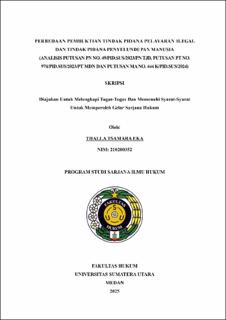
| dc.title | Perbedaan Pembuktian Tindak Pidana Pelayaran Ilegal dan Tindak Pidana Penyelundupan Manusia (Analisis Putusan PN No. 49/Pid.Sus/2023/PN Tjb, Putusan PT No. 974/Pid.Sus/2023/PT Mdn dan Putusan MA No. 444 K/Pid.Sus/2024) | en_US |
| dc.title.alternative | Differences in Evidence of Illegal Shipping Crime and People Smuggling Crime (Analysis of District Court Decision No. 49/Pid.Sus/2023/PN Tjb, Court Decision No. 974/PID.SUS/2023/PT Mdn and Supreme Court Decision No. 444 K/Pid.Sus/2024) | en_US |
| dc.type | Thesis | en_US |
| dc.identifier.nim | NIM210200352 | |
| dc.identifier.nidn | NIDN0022126005 | |
| dc.identifier.nidn | NIDN0025077403 | |
| dc.identifier.kodeprodi | KODEPRODI74201#Ilmu Hukum | |
| dc.description.pages | 173 Pages | en_US |
| dc.description.type | Skripsi Sarjana | en_US |
| dc.subject.sdgs | SDGs 16. Peace, Justice And Strong Institutions | en_US |