| dc.contributor.advisor | Kamello, Tan | |
| dc.contributor.advisor | Barus, Utary Maharany | |
| dc.contributor.author | Sidabutar, Claudita Honeytya | |
| dc.date.accessioned | 2025-07-25T03:07:10Z | |
| dc.date.available | 2025-07-25T03:07:10Z | |
| dc.date.issued | 2025 | |
| dc.identifier.uri | https://repositori.usu.ac.id/handle/123456789/107417 | |
| dc.description.abstract | Islamic banks function as financial institutions that collect and distribute public funds to meet societal needs and facilitate payment system mechanisms across all economic sectors. Fictitious financing is a form of fraudulent activity within banking operations, often committed by internal parties, which results in financial losses for both customers and the bank itself. This issue highlights the importance of bank accountability toward customers who suffer losses due to the misuse of their identities in fictitious financing schemes. This study seeks to address the following research questions: (1) What categories of financing can be classified as fictitious financing in Islamic banking? (2) How is the bank held accountable for identity misuse committed for fictitious financing in Islamic banking? and (3) What legal protections are afforded to bank customers whose identities are misused in fictitious financing?
The research method used in this thesis is normative juridical research, focusing on the analysis of applicable legal norms. The data sources consist of secondary data supported by primary data obtained through interviews.
The results of this study indicate that fictitious financing is classified based on the elements outlined in Article 63 paragraph (1) of the Islamic Banking Law. Bank accountability toward affected customers is governed by Article 1365 and Article 1367 of the Indonesian Civil Code, Article 19 paragraph (1) of the Consumer Protection Law, and Article 10 paragraph (1) of the Financial Services Authority Regulation (POJK) Number 22 of 2023, which affirm the bank’s responsibility for unlawful acts committed by its employees due to the hierarchical relationship between employer and employee. Furthermore, the legal protection of customers affected by fictitious financing is regulated under Article 29 paragraph (2) of the Banking Law, Article 35 paragraph (1) of the Islamic Banking Law, Article 3 of POJK Number 22 of 2023, and POJK Number 12 of 2024. | en_US |
| dc.language.iso | id | en_US |
| dc.publisher | Universitas Sumatera Utara | en_US |
| dc.subject | Legal Protection | en_US |
| dc.subject | Bank Accountability | en_US |
| dc.subject | Fictitious Financing | en_US |
| dc.subject | Islamic Banking | en_US |
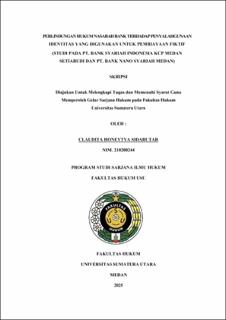
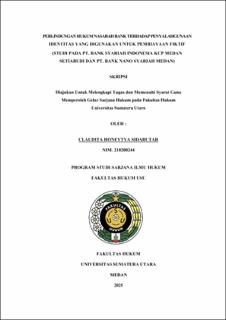
| dc.title | Perlindungan Hukum Nasabah Bank terhadap Penyalahgunaan Identitas yang Digunakan untuk Pembiayaan Fiktif (Studi pada PT. Bank Syariah Indonesia KCP Medan Setiabudi dan PT. Bank Nano Syariah Medan) | en_US |
| dc.title.alternative | Legal Protection of Bank Customers Against Misuse of Customer Identity for Fictitious Financing (Study at PT. Bank Syariah Indonesia KCP Medan Setiabudi and PT Bank Nano Syariah Medan) | en_US |
| dc.type | Thesis | en_US |
| dc.identifier.nim | NIM210200244 | |
| dc.identifier.nidn | NIDN0021046206 | |
| dc.identifier.nidn | NIDN0014017501 | |
| dc.identifier.kodeprodi | KODEPRODI74201#Ilmu Hukum | |
| dc.description.pages | Pages 157 | en_US |
| dc.description.type | Skripsi Sarjana | en_US |
| dc.subject.sdgs | SDGs 4. Quality Education | en_US |