| dc.contributor.advisor | Purba, Hasim | |
| dc.contributor.advisor | Sembiring, Idha Aprilyana | |
| dc.contributor.author | Lumbantobing, Hans Marcellino Bungaran | |
| dc.date.accessioned | 2025-07-25T04:23:09Z | |
| dc.date.available | 2025-07-25T04:23:09Z | |
| dc.date.issued | 2025 | |
| dc.identifier.uri | https://repositori.usu.ac.id/handle/123456789/107443 | |
| dc.description.abstract | The need for a house must be met by every human being. This basic need was responded to by the government by issuing PP Number 64 of 2016 concerning the development of low-income housing. Therefore, business actors take advantage of this opportunity by offering housing products with a practical method, namely brochures. This offer provides convenience, however, this convenience actually provides legal light for consumers where what has been agreed upon in the Sales and Purchase Agreement (PPJB) and brochures between the parties does not correspond to reality so that this research is formulated with the following problems: 1). How is the Regulation of the Sales and Purchase Agreement (PPJB) With Marketing Through Brochures? 2). How is the Developer's Accountability for Mismatched Orders in the Sales and Purchase Agreement (PPJB) With Marketing Through Brochures in Bekala Independent City Phase II? 3). What are the Legal Efforts for Consumers of Bekala Independent City Phase II Housing for Defaults Made by Developers in the Sales and Purchase Agreement (PPJB) With Marketing Through Brochures?
This type of research is empirical legal research whose data sources consist of primary data sources in the form of interviews and questionnaires to consumers and the marketing team. In addition, this research is also supported by secondary data sources in the form of literature studies, namely laws and regulations, journals, articles, theses, and legal dictionaries related to the problems studied.
The results of this study indicate that there is a discrepancy in the order in the sale and purchase agreement and brochure, in this case the wall separating the house is not made, the material is not good, and the PDAM water is late in entering the housing. The Developer's responsibility is to execute each of these consumer problems. The consumer's efforts are to make a Complaint to the Developer regarding the discrepancy received. This study recommends that the Developer be more careful in making clauses in the agreement and brochure that should be in accordance with the original. Then, the Developer should immediately follow up on the damage experienced by the consumer. | en_US |
| dc.language.iso | id | en_US |
| dc.publisher | Universitas Sumatera Utara | en_US |
| dc.subject | Responsibility | en_US |
| dc.subject | Developer | en_US |
| dc.subject | Sale and Purchase Agreement | en_US |
| dc.subject | Brochure | en_US |
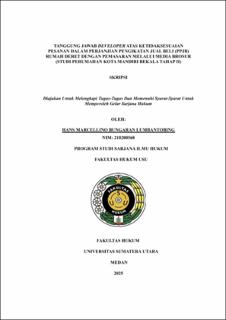
| dc.title | Tanggung Jawab Developer atas Ketidaksesuaian Pesanan dalam Perjanjian Pengikatan Jual Beli (PPJB) Rumah Deret dengan Pemasaran Melalui Media Brosur (Studi Perumahan Kota Mandiri Bekala Tahap II) | en_US |
| dc.title.alternative | Developer’s Responsibility for Non-Caompability of Orders in The Sale Purchase Agreement (PPJB) of Roof Houses with Marketing Through Brochure Media (Study of Kota Mandiri Bekala Phase II) | en_US |
| dc.type | Thesis | en_US |
| dc.identifier.nim | NIM210200568 | |
| dc.identifier.nidn | NIDN0003036602 | |
| dc.identifier.nidn | NIDN0014047609 | |
| dc.identifier.kodeprodi | KODEPRODI74201#Ilmu Hukum | |
| dc.description.pages | 160 Pages | en_US |
| dc.description.type | Skripsi Sarjana | en_US |
| dc.subject.sdgs | SDGs 16. Peace, Justice And Strong Institutions | en_US |