
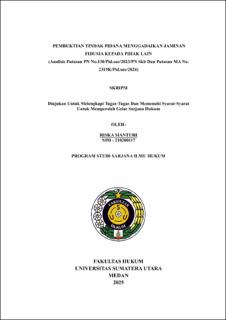
Pembuktian Tindak Pidana Menggadaikan Jaminan Fidusia Kepada Pihak Lain (Analisis Putusan PN No.130/Pid.sus/2023/PN Skb dan Putusan MA No. 2319 K/Pid.sus/2024)
Proof of The Crime of Mortgaging Fiduciary Collateral to Another Party (Analysis of District Court Decision No. 130/Pid.Sus/2023/PN Skb and Supreme Court Decision No. 2319K/Pid.Sus/2024)
Abstract
The development of an increasingly advanced era is often accompanied by an increase in increasingly sophisticated and diverse criminal acts. Technological advances and social change can trigger the emergence of new, more complex crime modes, thus potentially causing financial losses. Fiduciary crimes are one form of crime that often occurs. Judges have the responsibility to handle every case submitted, including accepting, examining, and deciding the case fairly and in accordance with applicable law. The problem in this thesis entitled Proving the crime of pawning fiduciary collateral to another party is how are the regulations related to fiduciary crimes in Indonesia? How is the proof of the defendant's guilt related to the judge's decision in a criminal case? How are the judge's considerations different in proving the element of the fiduciary giver in the crime of pawning fiduciary collateral to another party in the District Court Decision No.130/Pid.sus/2023/PN Skb and the Supreme Court Decision No. 2319K/Pid.sus/ 2024? The research in this paper was conducted with normative legal research, and the data used in this study is secondary data and then analyzed qualitatively with a descriptive research nature. The regulation of fiduciary crimes is regulated in Article 35 and Article 36 of Law No. 42 of 1999 concerning Fiduciary Guarantees. The regulation of evidence in Indonesia is regulated in the Criminal Procedure Code and in several other special laws. Based on Article 183 of the Criminal Procedure Code, the evidentiary system in Indonesia adopts a negative statutory evidentiary system. Ultimately, based on the results of this study, it was concluded that the panel of judges at the Sukabumi District Court had made a mistake in considering the relevant legal facts legally correctly and properly according to the legal facts. Therefore, the Supreme Court judges overturned the District Court Decision on the grounds that based on the evidence at trial, legal facts had been obtained that proved that the Defendant had commited a crime in this case had fulfilled the elements in Article 36 of Law No. 42 of 1999 concerning Fiduciary Guarantees.
Collections
- Undergraduate Theses [3143]