| dc.contributor.advisor | Mulyadi, Mahmud | |
| dc.contributor.advisor | Lubis, Rafiqoh | |
| dc.contributor.author | Nazhifa, Nazhifa | |
| dc.date.accessioned | 2025-07-28T04:05:37Z | |
| dc.date.available | 2025-07-28T04:05:37Z | |
| dc.date.issued | 2025 | |
| dc.identifier.uri | https://repositori.usu.ac.id/handle/123456789/107607 | |
| dc.description.abstract | Law enforcement by judges plays a very important role in preventing and eradicating all forms of deviant acts or behaviors, such as in the case of the crime of sexual intercourse, where the consequences of such crimes are very detrimental to the victims, especially children. The problems discussed in this thesis are: 1) How is the regulation regarding the crime of sexual intercourse against minors in Indonesian positive law, 2) How are the objectives and sentencing guidelines for perpetrators of criminal acts and their relation to the protection of child victims, 3) How is sentencing imposed on perpetrators of sexual intercourse with minors in decision number 1/Pid.S/2023/PN Mdn and decision number 901/Pid.Sus/2023/PT Mdn from the perspective of sentencing objectives and protection of child victims. The method used in this writing is normative legal research which is descriptive in nature with qualitative data analysis and the type of data used is secondary data obtained from primary legal materials, secondary legal materials, and tertiary legal materials. The crime of sexual intercourse is regulated in the Criminal Code (KUHP) Article 287, while in the 2023 Criminal Code it is regulated in Article 473. As for special laws outside the Criminal Code, it is regulated in the Law on Domestic Violence (PKDRT), the Law on the Eradication of the Crime of Trafficking in Persons (TPPO), and the Law on Sexual Violence Crimes (TPKS). Sentencing guidelines are used by judges as tools to ensure that the punishment for the perpetrator is proportionate to the degree of suffering of the victim and to provide a deterrent effect to the perpetrator. Judges also consider the overall objectives of sentencing, prioritizing justice for the victim. In District Court Decision No. 1/Pid.S/2023/PN Mdn and High Court Decision No. 901/Pid.Sus/2023/PT Mdn, the defendant was proven to have violated Article 81 Paragraph (1) jo. Article 76D of the Child Protection Law (UUPA). The difference in consideration between the District Court and the High Court in sentencing the perpetrator was due to differences in perspective regarding sentencing guidelines and the objectives of punishment. | en_US |
| dc.language.iso | id | en_US |
| dc.publisher | Universitas Sumatera Utara | en_US |
| dc.subject | Sentencing Guidelines | en_US |
| dc.subject | Sentencing Objectives | en_US |
| dc.subject | Crime of Sexual Intercourse | en_US |
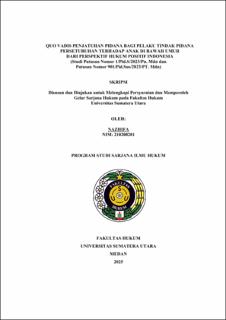
| dc.title | Quo Vadis Penjatuhan Pidana bagi Pelaku Tindak Pidana Persetubuhan terhadap Anak di Bawah Umur dari Perspektif Hukum Positif Indonesia (Studi Putusan Nomor 1/Pid.S/2023/PN Mdn dan Putusan Nomor 901/Pid.Sus/2023/PT Mdn) | en_US |
| dc.title.alternative | QUO VADIS SENTENCING FOR PERPETRATORS OF SEXUAL INTERCOURSE CRIMES AGAINST MINORS FROM THE PERSPECTIVE OF INDONESIAN POSITIVE LAW (Study of Decision Number 1/Pid.S/2023/PN Mdn and Decision Number 901/Pid.Sus/2023/PT Mdn) | en_US |
| dc.type | Thesis | en_US |
| dc.identifier.nim | NIM210200201 | |
| dc.identifier.nidn | NIDN0001047403 | |
| dc.identifier.nidn | NIDN0025077403 | |
| dc.identifier.kodeprodi | KODEPRODI74201#Ilmu Hukum | |
| dc.description.pages | 188 Pages | en_US |
| dc.description.type | Skripsi Sarjana | en_US |
| dc.subject.sdgs | SDGs 16. Peace, Justice And Strong Institutions | en_US |