| dc.contributor.advisor | Saidin, OK | |
| dc.contributor.advisor | Chairi, Zulfi | |
| dc.contributor.author | Thalib, Ghina Fauziyah | |
| dc.date.accessioned | 2025-07-28T08:05:12Z | |
| dc.date.available | 2025-07-28T08:05:12Z | |
| dc.date.issued | 2025 | |
| dc.identifier.uri | https://repositori.usu.ac.id/handle/123456789/107690 | |
| dc.description.abstract | Musical works are artworks that are closely tied to everyday life, especially
with the advent of technology. In addition, song recordings are an important part
of musical works; music and song recordings are two inseparable elements. Music
art in Indonesia is growing increasingly significant and often involves
collaboration between creators and other parties. This is why copyright regulations
must be adapted to technological advancements and innovations over time to better
protect creators' rights. The case study of Taylor Swift's legal battle over her song
recordings with Big Machine Records is used to illustrate the use of rights as a
creator.
This research method uses a normative legal approach applied through an
analysis of regulations related to agreements and copyright. The main focus of this
research is to examine the regulations comparing Indonesian and US laws on song
re-recording by songwriters and the legal protection provided by both countries.
The dispute was resolved non-litigiously by relying on the rights as a
creator. It was found that Indonesian and US law allow the re-recording of songs
with new versions by songwriters. This study found that US law provides explicit
regulations on the differences between musical works and song recordings. The
United States divides musical works and song recordings into two separate
copyright objects, while Indonesia does not divide musical works and song
recordings into two separate copyright objects, but instead includes song
recordings under related rights. The results of this study conclude that copyright
law in Indonesia is already quite good in regulating creative works, but the
differences between musical works and song recordings, as well as other elements,
need to be clarified further to create regulations that are not easily manipulated. | en_US |
| dc.language.iso | id | en_US |
| dc.publisher | Universitas Sumatera Utara | en_US |
| dc.subject | Protection | en_US |
| dc.subject | Copyright | en_US |
| dc.subject | Song Recordings | en_US |
| dc.subject | Agreement | en_US |
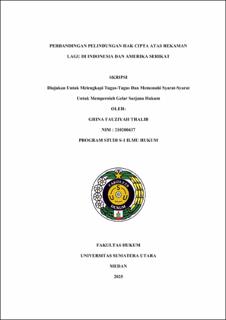
| dc.title | Perbandingan Pelindungan Hak Cipta atas Rekaman Lagu di Indonesia dan Amerika Serikat | en_US |
| dc.title.alternative | Comparison of Copyright Protection For Music Recordings in Indonesia and the United States | en_US |
| dc.type | Thesis | en_US |
| dc.identifier.nim | NIM210200437 | |
| dc.identifier.nidn | NIDN0013026203 | |
| dc.identifier.nidn | NIDN0001087102 | |
| dc.identifier.kodeprodi | KODEPRODI74201#Ilmu Hukum | |
| dc.description.pages | 92 Pages | en_US |
| dc.description.type | Skripsi Sarjana | en_US |
| dc.subject.sdgs | SDGs 16. Peace, Justice And Strong Institutions | en_US |