| dc.contributor.advisor | Saidin, OK | |
| dc.contributor.advisor | Sitepu, Faradila Yulistari | |
| dc.contributor.author | Sitio, Rachel Velicia Theo Fany Saragih | |
| dc.date.accessioned | 2025-07-28T08:16:30Z | |
| dc.date.available | 2025-07-28T08:16:30Z | |
| dc.date.issued | 2025 | |
| dc.identifier.uri | https://repositori.usu.ac.id/handle/123456789/107694 | |
| dc.description.abstract | Legal Protection of Well-Known Trademarks in Indonesia still faces significant challenges, particularly in proving bad faith and in the absence of clear criteria for determining a well-known mark. Although Law No. 20 of 2016 regulates such protection, its implementation remains suboptimal. One case that illustrates this issue is the dispute between BOSE Corporation and LFC, in which the Directorate General of Intellectual Property (DGIP) approved the registration of the "BOSE" trademark by LFC, despite its substantial similarity to BOSE Corporation's well-known mark and indications of bad faith in the application. This case highlights gaps in regulation, weaknesses in the verification system, and the insufficient protection of well-known trademarks in Indonesia’s trademark registration process.
This research adopts a normative juridical method, utilizing both primary and secondary data through library research and field research. It analyzes the relevant legal provisions in the case as well as other scholarly sources pertinent to the subject matter.
The findings of this study conclude that the Commercial Court recognized the bad faith of LFC in registering the “BOSE” mark, which bears substantial similarity to the well-known trademark owned by BOSE Corporation. Well-known marks are often subject to infringement due to their strong reputation, leading others to imitate or exploit their goodwill. Despite being regulated under Law No. 20 of 2016, the Paris Convention, and the TRIPs Agreement, the protection of well-known marks in Indonesia remains weak due to vague assessment standards, inconsistent enforcement, and limitations in DGIP’s authority to reject applications without formal opposition. Effective protection largely depends on the proactive role of the trademark owner and judicial decisions. In this case, the court ruled that LFC’s registration violated Article 21 of the Trademark Law, as it sought to capitalize on the reputation of an already well-established mark, and consequently annulled the registration to uphold fair legal protection. | en_US |
| dc.language.iso | id | en_US |
| dc.publisher | Universitas Sumatera Utara | en_US |
| dc.subject | Well-Known Mark | en_US |
| dc.subject | Bad Faith | en_US |
| dc.subject | Substantial Similarity | en_US |
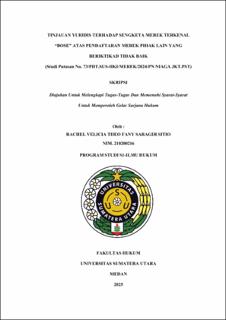
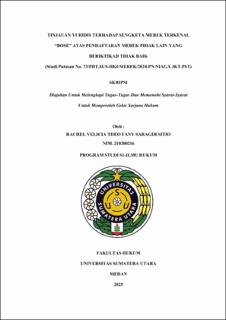
| dc.title | Tinjauan Yuridis Terhadap Sengketa Merek Terkenal “Bose” Atas Pendaftaran Merek Pihak Lain Yang Beriktikad Tidak Baik | en_US |
| dc.title.alternative | Legal Review Of The Dispute Over The Well-Known Trademark "BOSE" Resulting From Another Party's Bad Faithful Registration (Study of Decision No.73/Pdt.Sus-HKI/Merek/2024/PN Niaga Jkt.Pst) | en_US |
| dc.type | Thesis | en_US |
| dc.identifier.nim | NIM210200216 | |
| dc.identifier.nidn | NIDN0013026203 | |
| dc.identifier.nidn | NIDN0018078802 | |
| dc.identifier.kodeprodi | KODEPRODI74201#Ilmu Hukum | |
| dc.description.pages | 128 Pages | en_US |
| dc.description.type | Skripsi Sarjana | en_US |
| dc.subject.sdgs | SDGs 16. Peace, Justice And Strong Institutions | en_US |