| dc.contributor.advisor | Syahrin, Alvi | |
| dc.contributor.advisor | Marlina | |
| dc.contributor.author | Napitupulu, Febe Christanta | |
| dc.date.accessioned | 2025-07-28T08:35:59Z | |
| dc.date.available | 2025-07-28T08:35:59Z | |
| dc.date.issued | 2025 | |
| dc.identifier.uri | https://repositori.usu.ac.id/handle/123456789/107709 | |
| dc.description.abstract | Corruption in the form of gratification is a serious problem in Indonesia,
particularly within the tax bureaucracy. Directorate General of Taxes play a
crucial role in maintaining the integrity of tax administration. However, some of
them have been proven to abuse their authority by accepting gratifications, which
not only harm state finances but also reduce public trust. In many cases, the
perpetrators also engage in money laundering to conceal the origin of assets
obtained through acts of corruption. One concrete case that illustrates this issue is
Decision Number 07/Pid.Sus-TPK/2023/PN.Jkt.Pst. This thesis addresses three
main research questions: (1) how the law regulates the criminal act of gratification
and the crime of money laundering in Indonesia; (2) how the concept of criminal
liability is understood under Indonesian criminal law; and (3) how criminal
liability is applied in Decision Number 07/Pid.Sus-TPK/2023/PN.Jkt.Pst. This
research applies a normative juridical method with a statutory and case approach
and relies on secondary data derived from primary, secondary, and tertiary legal
sources. The results of this study indicate that the regulation of gratification as a
form of corruption is stipulated in Articles 12B and 12C of Law Number 20 of 2001
concerning the Eradication of Corruption. These provisions are closely related to
Law Number 28 of 1999, which defines the prohibitions and obligations of state
officials or civil servants. Both laws are also indirectly related to Law Number 30
of 2014 concerning Government Administration, which provides more detailed
regulation on the general principles of good governance and clearly distinguishes
between administrative misconduct and criminal acts. Money laundering is
regulated under Law Number 8 of 2010 concerning the Prevention and Eradication
of Money Laundering. The concept of criminal liability in Indonesian criminal law
serves as a framework for assessing whether an individual can be held legally
accountable for a criminal offense. It requires consideration of several elements:
the existence of a criminal act (actus reus), the presence of fault (mens rea), the
capacity of the perpetrator to be held responsible, and the absence of any
justification or excuse. In Decision Number 07/Pid.Sus-TPK/2023/PN.Jkt.Pst, the
panel of judges correctly considered the elements of gratification, the existence of
fault, the defendant's capacity to be held accountable, and the absence of any
justifying or excusing circumstances. Consequently, the defendant was found to be
criminally liable for his unlawful conduct | en_US |
| dc.language.iso | id | en_US |
| dc.publisher | Universitas Sumatera Utara | en_US |
| dc.subject | Criminal Liability | en_US |
| dc.subject | Corruption | en_US |
| dc.subject | Gratification | en_US |
| dc.subject | Money Laundering | en_US |
| dc.subject | Directorate General of Taxes Officials | en_US |
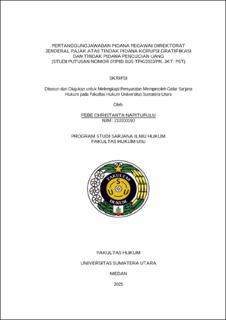
| dc.title | Pertanggungjawaban Pidana Pegawai Direktorat Jenderal Pajak atas Tindak Pidana Korupsi Gratifikasi dan Tindak Pidana Pencucian Uang (Studi Putusan No. 07/Pid.Sus-TPK/2023/PN. Jkt. Pst) | en_US |
| dc.title.alternative | Criminal Liability of Directorate General of Taxes Employees fot The Criminal Act Gratuity Corruption and Money Laundering (A Case Study of Decision Number 07/Pid.Sus-TPK/2023/PN. Jkt. Pst) | en_US |
| dc.type | Thesis | en_US |
| dc.identifier.nim | NIM210200190 | |
| dc.identifier.nidn | NIDN0031036302 | |
| dc.identifier.nidn | NIDN0007037501 | |
| dc.identifier.nidn | KODEPRODI74201#Ilmu Hukum | |
| dc.description.pages | 175 Pages | en_US |
| dc.description.type | Skripsi Sarjana | en_US |
| dc.subject.sdgs | SDGs 16. Peace, Justice And Strong Institutions | en_US |