| dc.contributor.advisor | Barus, Utary Maharany | |
| dc.contributor.advisor | Sitepu, Faradila Yulistari | |
| dc.contributor.author | Simanullang, Dea Novita | |
| dc.date.accessioned | 2025-07-28T08:39:23Z | |
| dc.date.available | 2025-07-28T08:39:23Z | |
| dc.date.issued | 2025 | |
| dc.identifier.uri | https://repositori.usu.ac.id/handle/123456789/107712 | |
| dc.description.abstract | In the Indonesia Copyright Law (UUHC), commercial use of a work is
an infringement of copyright. The Fair Use provision in the national copyright
law, known as ‘Kepentingan Yang Wajar’, also opposes the commercial use of
the work as referred to in Article 43 and Article 44 of the Republic Indonesia
Number 28 of 2014 of C, especially against works whose dissemination uses
technology and internet media. Meanwhile, in the digital era, social media has
a great influence on commercial activities, so that commercial use of creations
is inevitable. Creative Commons licences have the same concept as Fair Use,
regarding the limitation of the creator's exclusive rights. However, both have
different rules in viewing commercial use.
The research was conducted using the juridical-normative method by
referring to secondary data in the form of primary, secondary, and tertiary legal
materials, with a literature approach and comparative approach. Techniques
and data collection used are in the form of literature studies and interviews with
sources. Data analysis uses qualitative analysis with deductive inference
method for drawing conclusions.
The results showed that the Kepentingan Yang Wajar contained in
Chapter VI Copyright Restrictions in Article 43- Article 51 of the national
copyright law does not allow commercial use of copyrighted works unless the
user requests prior permission from the creator and the creator does not object
to such use. Commercial use can be done by entering into a licence agreement
with the creator/copyright holder of the work to be used. The exception of
commercial use within the limits of Kepentingan Yang Wajar in the national
copyright law results in any commercial use of copyrighted works without
permission cannot be considered a defence of Kepentingan Yang Wajar (Fair
Use). Creative Commons licences offer three of the licences that allow
commercial use of copyrighted works without granting royalties and requesting
permission from the creator. Although they are licences, commercial use is
allowed to the user by the creator without payment of royalties, provided that
in their use the user complies with all the conditions contained in each Creative
Commons licences. | en_US |
| dc.language.iso | id | en_US |
| dc.publisher | Universitas Sumatera Utara | en_US |
| dc.subject | Fair Use | en_US |
| dc.subject | Creative Commons | en_US |
| dc.subject | Commercial Use | en_US |
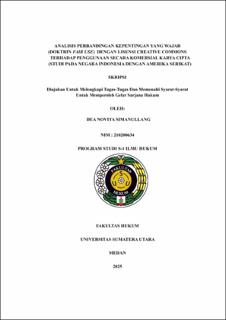
| dc.title | Analisis Perbandingan Kepentingan yang Wajar (Doktrin Fair Use) dengan Lisensi Creative Commons terhadap Penggunaan secara Komersial Karya Cipta (Studi pada Negara Indonesia dengan Amerika Serikat) | en_US |
| dc.title.alternative | Comparative Analysis of Kepentingan Yang Wajar (Fair Use Doctrine) With Creative Commons License For Commercial Use of Copyrighted Works (Study on Indonesia and the United States) | en_US |
| dc.type | Thesis | en_US |
| dc.identifier.nim | NIM210200634 | |
| dc.identifier.nidn | NIDN0014017501 | |
| dc.identifier.nidn | NIDN0018078802 | |
| dc.identifier.kodeprodi | KODEPRODI74201#Ilmu Hukum | |
| dc.description.pages | 118 Pages | en_US |
| dc.description.type | Skripsi Sarjana | en_US |
| dc.subject.sdgs | SDGs 8. Decent Work And Economic Growth | en_US |