
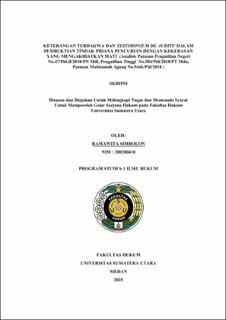
Keterangan Terdakwa dan Testimonium De Auditu dalam Pembuktian Tindak Pidana Pencurian dengan Kekerasan yang Mengakibatkan Mati (Analisis Putusan Pengadilan Negeri No.47/Pid.B/2018/PN Mdl, Pengadilan Tinggi No.504/Pid/2018/PT Mdn, Putusan Mahkamah Agung No.944k/Pid/2018 )
Defendant’s Testimony and Testimonium de Auditu in the Evidence of Violent Theft Resulting in Death (An Analysis of the Decision of the District Court No. 47/Pid.B/2018/PN Mdl, High Court Decision No. 504/Pid/2018/PT Mdn, and Supreme Court Decision No. 944 K/Pid/2018)
Abstract
This research examines the defendant's testimony and testimonium de auditu in the evidentiary process of the criminal offense of violent theft resulting in death. The study is prompted by discrepancies in decisions among the District Court, the High Court, and the Supreme Court concerning the same case, which reflect differing assessments of evidence, particularly the defendant's testimony and hearsay witness statements (testimonium de auditu). The main issues discussed include: the legal framework governing violent theft resulting in death, the evidentiary status of the defendant's testimony and testimonium de auditu in Indonesia's criminal justice system, and the judges’ considerations in rendering decisions based on these two forms of evidence.
The research employs a normative juridical method with a statutory and case study approach, analyzing decisions from all three levels of the judiciary. The findings indicate that testimonium de auditu holds weak legal standing, as it is not based on direct knowledge, although it may still be considered if supported by other evidence. Meanwhile, the defendant's testimony also cannot stand alone as the primary means of proof. The differences in judicial reasoning across the three court levels underscore the complexity and caution required in assessing the validity of evidence. This research recommends that judges exercise greater prudence in evaluating testimonium de auditu and calls for the strengthening of regulations concerning indirect evidence to prevent potential injustices in criminal proceedings.
Collections
- Undergraduate Theses [3143]