| dc.contributor.advisor | Nelvita | |
| dc.contributor.author | Siallagan, Rika Oktavia | |
| dc.date.accessioned | 2025-07-31T07:03:21Z | |
| dc.date.available | 2025-07-31T07:03:21Z | |
| dc.date.issued | 2025 | |
| dc.identifier.uri | https://repositori.usu.ac.id/handle/123456789/107939 | |
| dc.description.abstract | This final project focuses on the ohitorisama phenomenon, namely the culture of living as a single individual which is increasingly popular in modern Japan. In this context, ohitorisama refers to individuals who choose to live life without a partner, not only in terms of marital status but also in aspects of daily life such as eating, traveling, and other recreational activities. This writing aims to provide an overview of how ohitorisama culture developed in Japanese society and how social, economic and demographic changes contributed to the acceptance of this lifestyle. Using various literary sources, articles, and popular culture references, the author outlines the factors that drove the growth of the ohitorisama lifestyle and how Japanese society adapted to these changes. | en_US |
| dc.language.iso | id | en_US |
| dc.publisher | Universitas Sumatera Utara | en_US |
| dc.subject | ohitorisama | en_US |
| dc.subject | single lifestyle | en_US |
| dc.subject | Japan | en_US |
| dc.subject | social change | en_US |
| dc.subject | modern culture | en_US |
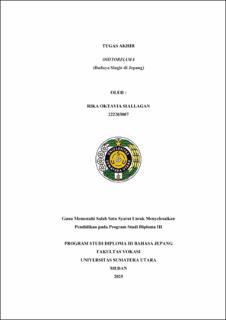
| dc.title | Ohitorisama (Budaya Single di Jepang) | en_US |
| dc.title.alternative | Ohitorisama (Single Culture in Japan) | en_US |
| dc.type | Thesis | en_US |
| dc.identifier.nim | NIM222203007 | |
| dc.identifier.nidn | NIDN003118404 | |
| dc.identifier.kodeprodi | KODEPRODI79404#Bahasa Jepang | |
| dc.description.pages | 45 Pages | en_US |
| dc.description.type | Kertas Karya Diploma | en_US |
| dc.subject.sdgs | SDGs 4. Quality Education | en_US |