| dc.contributor.advisor | Lubis, Rafiqoh | |
| dc.contributor.advisor | Trisna, Wessy | |
| dc.contributor.author | Sinaga, Eggy Putri Elisabet | |
| dc.date.accessioned | 2025-09-12T02:45:14Z | |
| dc.date.available | 2025-09-12T02:45:14Z | |
| dc.date.issued | 2024 | |
| dc.identifier.uri | https://repositori.usu.ac.id/handle/123456789/108379 | |
| dc.description.abstract | Proving the element of intention in a criminal act is a key element that affects the final decision in the trial. In murder cases, judges apply stricter standards of proof of intent, where intent is considered a crucial element that must be proven beyond a reasonable doubt. On the other hand, in cases of persecution resulting in death, in addition to intent, the judge also considers aspects of culpa or negligence, suggesting that the standard of proof may be more flexible depending on the context of the crime. This thesis contains several formulations of the problem, namely as follows: 1) How to Regulate the Crime of Murder and Persecution Resulting in Death According to Criminal Law in Indonesia; 2) How is the relationship between the element of intention and the proof of criminal cases; 3) How to Analyze the Difference in Judges' Considerations in Proving the Element of Intent for the Crime of Murder and Persecution Resulting in Death in PN Decision No.59/Pid.B/2021/PN Lbh and PT Decision No.10/Pid/2022/PT TTE. This study uses a normative juridical method with a case study approach to explore how judges interpret and apply the element of intention in two different criminal cases. The normative juridical approach involves an analysis of relevant laws and regulations, legal doctrines, and related court decisions. At the end of this study, it can be concluded that there is a difference in the decision between the District Court No.59/Pid.B/2021/PN Lbh and the High Court Decision No. 10/Pid/2022/PT TTE related to the judge's approach to proving the element of intention in the crime of murder and persecution resulting in death. Judges in District Courts tend to rely more on evidence such as witness statements and physical evidence to determine the existence of elements of intent, while at the appellate level, judges focus more on legal interpretation and the application of pre-existing jurisprudence. The difference in judges' considerations reflects variations in legal interpretation related to intentions and intentions in criminal acts. These findings highlight the need for consistency and clarity in the application of evidentiary standards to ensure substantive justice in the criminal justice system. | en_US |
| dc.language.iso | id | en_US |
| dc.publisher | Universitas Sumatera Utara | en_US |
| dc.subject | Judge's Consideration | en_US |
| dc.subject | Element of Intent | en_US |
| dc.subject | Criminal Acts | en_US |
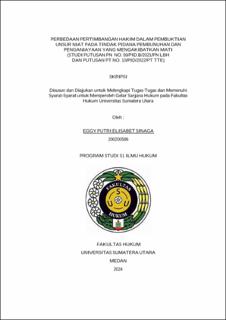
| dc.title | Perbedaan Pertimbangan Hakim dalam Pembuktian Unsur Niat pada Tindak Pidana Pembunuhan dan Penganiayaan yang Mengakibatkan Mati (Studi Putusan PN No. 59/Pid.B/2021/PN LBH dan Putusan PT No. 10/PID/2022/PT TTE) | en_US |
| dc.title.alternative | Difference in Judges Considerations in Proving the Element of Intent for the Crime of Murder and Persecution Resulting in Death (Study of PN Decision No.59/ Pid.B/2021/PN LBH and PT Decision No.10/Pid/2022/PT TTE) | en_US |
| dc.type | Thesis | en_US |
| dc.identifier.nim | NIM200200586 | |
| dc.identifier.nidn | NIDN0025077403 | |
| dc.identifier.nidn | NIDN0123018601 | |
| dc.identifier.kodeprodi | KODEPRODI74201#Ilmu Hukum | |
| dc.description.pages | 133 Pages | en_US |
| dc.description.type | Skripsi Sarjana | en_US |
| dc.subject.sdgs | SDGs 16. Peace, Justice And Strong Institutions | en_US |